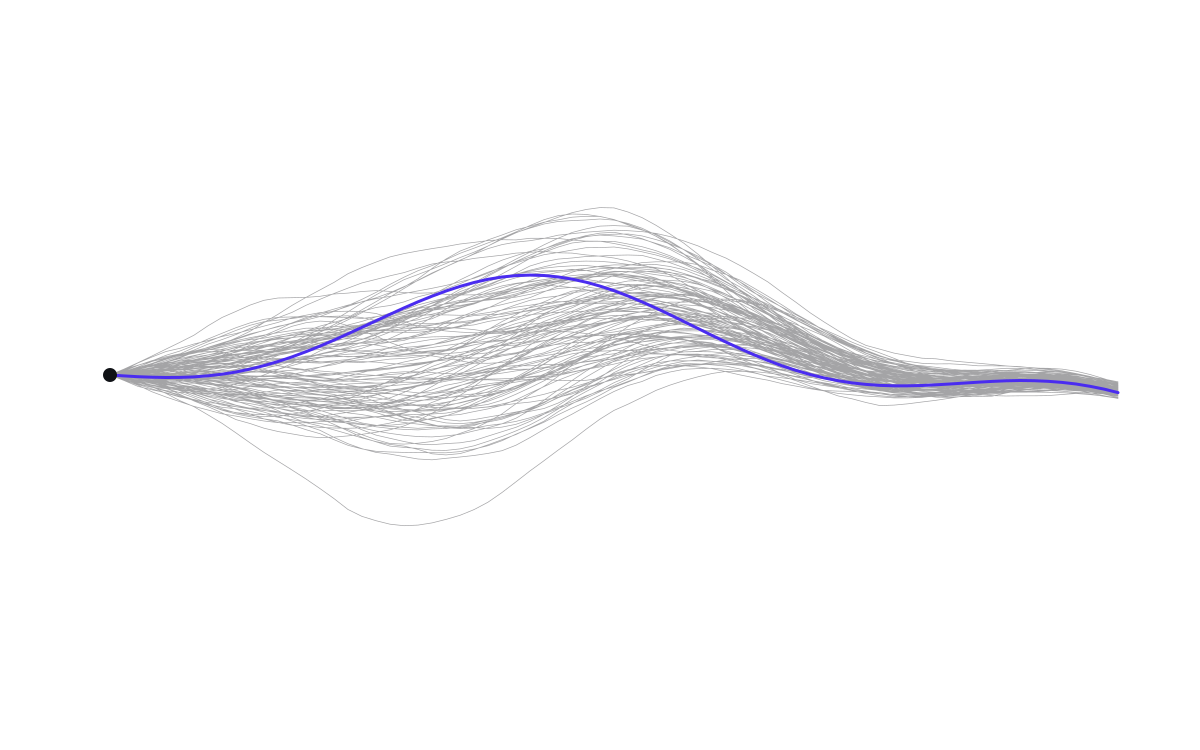
The Only Rehearsal
NASA hit an asteroid on purpose in 2022 and it worked better than anyone had said it would. This month a European probe arrives to find out why, and the harder gaps in planetary defence turn out to be before and after the rocket.
Nearfi scores DART, the Double Asteroid Redirection Test (2022) 8.3/10 as art. It did what a film only imagines: a real spacecraft changed the motion of a real asteroid, and beat its own success threshold more than 25 times over. As prophecy, its P(n) is 95%: The push has been demonstrated; the survey, the second rehearsal and the authority to launch are all still being built.
- It did what a film only imagines: a real spacecraft changed the motion of a real asteroid, and beat its own success threshold more than 25 times over.
- It was one shot at one rubble pile, and we still can't say exactly why it worked so well, which keeps it short of a method.
- The mission was the easy part of planetary defence; finding the rock early and deciding who launches are still unfinished.
The push has been demonstrated; the survey, the second rehearsal and the authority to launch are all still being built.
- ARRIVED A spacecraft can measurably change the motion of an asteroid by hitting it (the kinetic impactor).
- NEAR Most asteroids big enough to devastate a region are found years or decades before they could hit.
- NEAR The outcome of a deflection can be predicted well enough in advance to plan one against a real threat.
The push has been demonstrated; the survey, the second rehearsal and the authority to launch are all still being built.
The success threshold was 73 seconds.
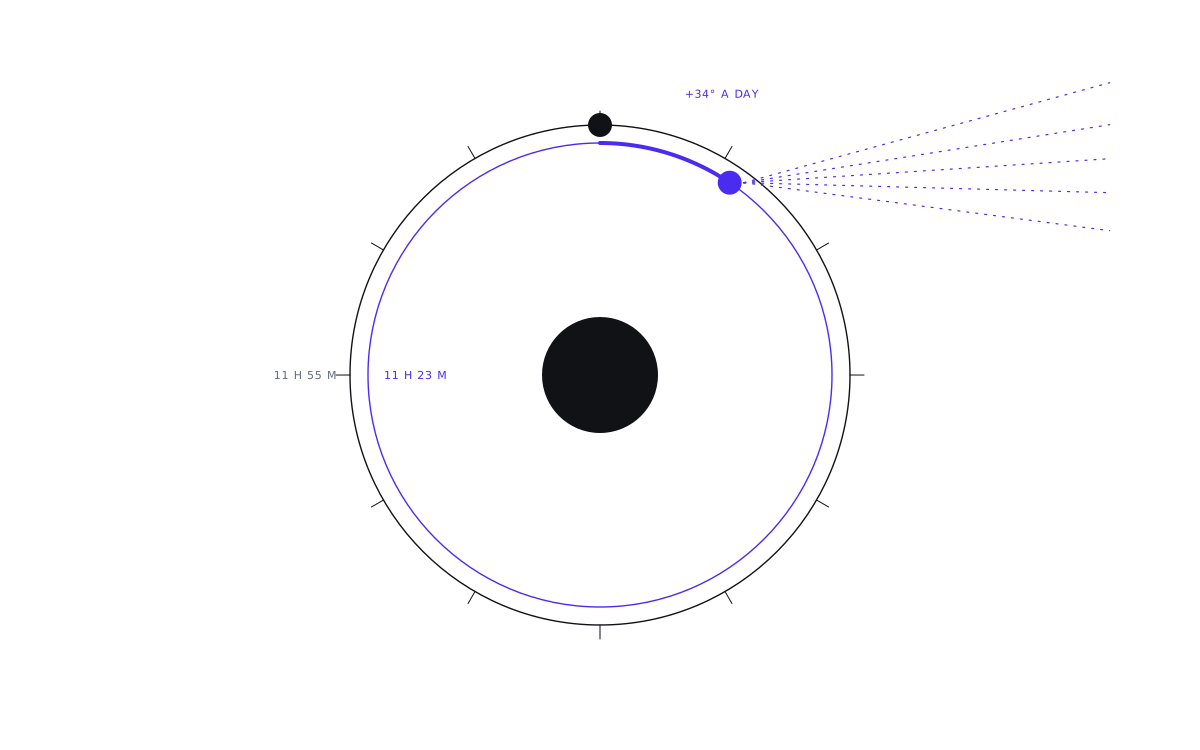
Before NASA's DART spacecraft hit the asteroid moonlet Dimorphos on 26 September 2022, the mission had a number that would count as a win: the moonlet's orbit around its parent asteroid, Didymos, had to get shorter by at least 73 seconds. On 11 October, NASA and the Johns Hopkins Applied Physics Laboratory reported that it had got shorter by 32 minutes, give or take two. The orbit had been 11 hours and 55 minutes. Now it was 11 hours and 23. The mission had beaten its own bar more than 25 times over.
ESA now rounds the change to about 33 minutes. Whichever you use, ESA's mission manager describes Dimorphos as the first object in the Solar System to have its orbit measurably shifted by human action. This month a second spacecraft arrives to find out how.
This is the second "Reality, reviewed": real technology scored the way we score fiction, as a work and as a prophecy.
The work
Strip away the engineering and DART is a very simple film. A spacecraft launched on a Falcon 9 on 24 November 2021 flies for ten months at a small moonlet and hits it at about 6 km/s. ESA's figure is 6.1. The moonlet, Dimorphos, was described by NASA at the time as 160 metres across; ESA now gives 151. It was chosen because it orbits a bigger asteroid, 780 metres across, which makes its motion easy to time from Earth with ordinary telescopes. Nobody had to guess the result. Astronomers just had to watch the eclipses.
The whole project cost about $325 million, by the Planetary Society's tally of the budget. For that we got a measurement, and measurements are what this field had been short of. The Italian Space Agency's cubesat LICIACube, released from DART before the impact, flew past Dimorphos and watched it.
The surprise is the number. The impact transferred more momentum than the spacecraft carried, because debris thrown off the surface pushed back like exhaust. The ratio, called beta, came out at 3.61 in the main Nature paper (plus 0.19, minus 0.25), assuming Dimorphos and Didymos have the same density. In other words, impact and ejecta together shoved the moonlet about three and a half times harder than the spacecraft's own momentum would have. NASA's own Lori Glaze called the 32 minutes "consistent with our estimates beforehand, but clearly at the upper end of that range". ESA, writing this autumn, is blunter: it asks which properties of the asteroid explain "a deflection so much greater than impact simulations predicted".
That is the caveat that keeps the score from going higher. A beta of 3.6 assumes a density we don't know. The same paper allows anything from 2.2 to 4.9 depending on the mass of Dimorphos, because nobody has weighed it. One impact on one pile of rubble is a proof of concept. It isn't a method.
And it is a very good proof of concept, with a team that knew exactly what it was doing and said so honestly. On the art, I'd give it nine. I've knocked it down to 8.3 because a test isn't a defence.
The sequel
The reason this is on the front page this month is that the sequel is arriving. ESA's Hera launched on 7 October 2024. Its job is the crash-site investigation: how big is the crater, did the asteroid reshape itself, what is it made of, how much does it weigh. On 18 October it took the picture that matters for the story, from 1,280 km out, in which Dimorphos was about one pixel, but a pixel clearly apart from Didymos. The probe had slowed itself to 20 m/s relative to the pair with two thruster firings a week apart. ESA's mission manager, Ian Carnelli, says the first detailed images of Dimorphos will be shown on 25 November.
Then two shoebox-sized cubesats are due to go closer, and the plan ends, eventually, with a landing. If Hera pins down the mass, the biggest uncertainty in beta shrinks. That's the difference between "it worked" and "we could do it again to something that was aimed at us".
The prophecy: what the film told us to worry about
It's worth setting DART against Don't Look Up, because the film got it half right. Adam McKay's 2021 comedy, released a few weeks after DART launched, gives its scientists about six months before a comet hits. It was meant as an allegory for climate change, and it is more about the media and the politicians than about the comet. In it, Rob Morgan plays the head of the Planetary Defense Coordination Office, which is a real NASA office, and the one that funded DART.
The film's fear was that we'd know and not act. The real record so far is the other way round. When the act was a small, well-defined engineering job, it got done, on schedule and under a threshold nobody expected to be beaten. The weak points are earlier and later.
Earlier: finding the rock. You can only deflect what you've found, and the survey of the big ones is unfinished. Congress mandated a search for 90 per cent of near-Earth asteroids larger than 140 metres in 2005. NASA's dedicated infrared telescope for it, NEO Surveyor, is now scheduled to launch no earlier than September 2027, after a succession of proposals that weren't picked for launch between 2006 and 2017. The small ones arrive unannounced. The object that burst over Chelyabinsk in February 2013 was about 17–20 metres across, and nobody saw it before it hit the air.
2024 YR4 was the closest this came to a live exercise. It was found on 27 December 2024. By 18 February 2025 its chance of hitting Earth in December 2032 peaked at 3.1 per cent; by 23 February new observations had taken its Torino rating to zero. For a while it also had a small chance of hitting the Moon, which NASA ruled out in March 2026 with Webb observations. All of that happened without anyone launching anything. That's the good news. I couldn't find any deflection mission begun for it, and had the odds gone the other way, I could find no interceptor ready to fly. DART is a proof; it is not a defence on a pad.
Later: who decides. The international machinery exists, and it's more serious than most people know. The UN-endorsed International Asteroid Warning Network handles detection and warning. The Space Mission Planning Advisory Group, set up by space agencies on a UN mandate, develops reference plans for a deflection campaign. Both coordinate and recommend, as the UN and ESA describe them. Nothing I could find gives either of them the power, or the money, to launch. A deflection is, in the end, a national decision about a global hazard, and the first one will be a political event before it is an engineering one. That is the part Don't Look Up was really about, and it is the part DART can't test.
Nearness: ARRIVING. The push is real. 2029 will be the next rehearsal: on 13 April 2029 the asteroid Apophis passes about 31,600 km above Earth, close enough that it should be visible to the naked eye in parts of Europe, Africa and western Asia, and both NASA's OSIRIS-APEX and ESA's Ramses are planned to study it.
What to do with it
Go and look at 25 November, when Hera's first sharp images of Dimorphos are due. It will be the first time we see what a thing we did to the sky looked like up close.
And watch the budget line for the survey telescope, which is the part nobody films. We have shown we can move a rock. The next test is whether we get around to looking for the ones that matter before we need to.
We rehearsed the end once, and it went well. It's the only rehearsal we've had.
What it predicted, and what happened
The core promise of planetary defence, that a spacecraft can change an asteroid's motion, was kept in 2022 and beat its own bar by more than 25 times. The rest of the chain is unfinished: the survey that finds the rock, a repeatable and predictable method, a spacecraft that could be built in the warning time, and a body with the authority to launch it.
How this P(n) was calculated
P(n) is the chance that this work's future arrives within 20 years, by 2046. For each prediction we turn our estimate into a probability: arrived is 100%, diverged is 0%, and otherwise the low end of our 80% range counts as a 10% chance, the median year 50% and the high end 90%. Each prediction is weighted 1–5 by how pivotal it is to the story, and P(n) is the weighted average. P50 does the same by 2076. P(n), explained.
| Claim | Prediction · why this weight | Weight | Status · estimate | By 2046 | By 2076 |
|---|---|---|---|---|---|
| DART-1 | A spacecraft can measurably change the motion of an asteroid by hitting it (the kinetic impactor). Core premise: the whole mission, and the idea of planetary defence by impact, rests on this. |
5 | ARRIVED arrived 2022 | 100% | 100% |
| DART-2 | The outcome of a deflection can be predicted well enough in advance to plan one against a real threat. Supporting: the test only becomes a method if the result can be predicted, but the headline deflection stands without it. |
3 | NEAR 2028 (2027–2031) | 100% | 100% |
| DART-3 | Most asteroids big enough to devastate a region are found years or decades before they could hit. Major: a deflection is only possible against a rock that has been found, so the whole defence depends on the survey. |
4 | NEAR 2035 (2032–2040) | 100% | 100% |
| DART-4 | A real deflection mission can be designed, built and launched within the warning time a newly found asteroid would give. Supporting: this is the gap between a demonstration and a defence, but the test itself did not need it. |
3 | NEAR 2038 (2032–2050) | 77% | 100% |
| DART-5 | An agreed international process exists to decide on, fund and launch a deflection before an impact. Supporting: the story of planetary defence is as much about who decides as about the rocket. |
3 | ARRIVING 2032 (2028–2045) | 91% | 100% |
| P(n) = P20 = Σ(weight × chance by 2046) ÷ Σ weight = 17.0 ÷ 18 = 95% | |||||
| P50 = 18.0 ÷ 18 = 100% | |||||
Already here today (arrived 1, arriving ½, weighted): 36%.
-
DART-1
A spacecraft can measurably change the motion of an asteroid by hitting it (the kinetic impactor).
Weight 5/5 · Core premise: the whole mission, and the idea of planetary defence by impact, rests on this.
DART hit Dimorphos on 26 September 2022 and shortened its orbit around Didymos from 11 hours 55 minutes to 11 hours 23, a change of about 32 minutes (later put at about 33). The pre-set success threshold was 73 seconds. The pair do not threaten Earth, so this was a test, not a rescue. 123
-
DART-2
The outcome of a deflection can be predicted well enough in advance to plan one against a real threat.
Weight 3/5 · Supporting: the test only becomes a method if the result can be predicted, but the headline deflection stands without it.
The momentum factor depends on Dimorphos's mass and density, which have not been measured; the main paper allows a range of about 2.2 to 4.9. ESA's Hera arrives in November 2026 and starts a science phase of around six months, and ESA says the open questions include why the deflection was so much greater than simulations predicted. Understanding one asteroid is not understanding all of them. 45
-
DART-3
Most asteroids big enough to devastate a region are found years or decades before they could hit.
Weight 4/5 · Major: a deflection is only possible against a rock that has been found, so the whole defence depends on the survey.
Congress set a goal in 2005 of finding 90 per cent of near-Earth asteroids over 140 metres. NASA's infrared survey telescope, NEO Surveyor, is scheduled to launch no earlier than September 2027, after earlier proposals were not selected between 2006 and 2017. Small objects such as the 17 to 20 metre one that burst over Chelyabinsk in 2013 arrive unseen. The 2024 YR4 case showed discovery and follow-up working, over about two months. 678
-
DART-4
A real deflection mission can be designed, built and launched within the warning time a newly found asteroid would give.
Weight 3/5 · Supporting: this is the gap between a demonstration and a defence, but the test itself did not need it.
DART flew as a planned test against a known, harmless target. No interceptor is standing ready, and the 2024 YR4 episode ended before any mission had to be started. Space agencies' stated plan is reference missions and test flights to prove the technology before a threat appears; a second kinetic test or a standing reference design would move this claim. 910
-
DART-5
An agreed international process exists to decide on, fund and launch a deflection before an impact.
Weight 3/5 · Supporting: the story of planetary defence is as much about who decides as about the rocket.
The International Asteroid Warning Network and the Space Mission Planning Advisory Group exist, with UN backing, to coordinate warning and to develop reference plans. As described by the UN and ESA, they coordinate and recommend. I found nothing giving either the authority or the money to launch, which would remain a national decision. 1112
- FOR NASA Confirms DART Mission Impact Changed Asteroid's Motion in Space. Johns Hopkins Applied Physics Laboratory, 2022-10-11. Period cut from 11 h 55 min to 11 h 23 min, about 32 minutes, against a 73-second minimum.
- FOR Momentum transfer from the DART mission kinetic impact on asteroid Dimorphos. Nature (open-access copy on PubMed Central), 2023-03-01. Cheng and colleagues report a momentum enhancement factor of 3.61 and conclude the impact was highly effective.
- CONTEXT DART mission page. NASA Science, 2026-11-03. NASA's own mission page: launch 24 November 2021, impact 26 September 2022.
- FOR First light: Hera resolves two asteroids instead of one. European Space Agency, 2026-10-27. Hera has slowed to 20 m/s relative to the pair; first detailed images of Dimorphos due 25 November.
- AGAINST Momentum transfer from the DART mission kinetic impact on asteroid Dimorphos. Nature (open-access copy on PubMed Central), 2023-03-01. Dimorphos's mass is poorly constrained, so the factor spans roughly 2.2 to 4.9; Hera is expected to narrow it.
- FOR NEO Surveyor. NASA Science, 2026-11-03. Infrared space telescope in development; launch no earlier than September 2027.
- AGAINST NEO Surveyor. Wikipedia, 2026-11-03. Records the 2005 congressional mandate and the repeated non-selection of survey proposals from 2006 to 2017.
- CONTEXT 2024 YR4. NASA Science, 2026-03-05. No significant Earth impact risk in 2032 and beyond; lunar impact in 2032 ruled out with Webb data.
- CONTEXT 2024 YR4. Wikipedia, 2026-11-03. Records no deflection mission for YR4 and says one would have been difficult to prepare in the time available.
- CONTEXT Getting ready for asteroids. European Space Agency, 2014-01-01. SMPAG is to develop reference missions, including precursor test missions, to fly before a real threat arises. Page undated in text; year approximate.
- FOR Media advisory: Open Forum on near-Earth Object impact hazards. United Nations Information Service Vienna, 2016-02-17. Says IAWN and SMPAG were established after UN General Assembly resolution 68/75 endorsed recommendations for an international response.
- CONTEXT Getting ready for asteroids. European Space Agency, 2014-01-01. SMPAG's task is to coordinate expertise and capabilities and recommend measures; it is not described as a launch authority.
Ledger updated 3 Nov 2026. Open this ledger as its own page · The P(n) Board · Method